Answer store questions and hand off to staff.
Give shoppers multilingual help with pickup, return policies and product locations. When a request needs a person, pass the question and its context to your team.

Answer the everyday question.
Finding the bathroom, understanding a return policy or checking how a service works should not require a search for staff. Give customers natural, multilingual access to approved store knowledge, and bring in a person when the request needs judgment or reassurance.
Illustrative homewares example using a fictional store policy. A shopper asks about returning an unopened kettle. The knowledge window shows that the service desk reviews the request and asks for the item and receipt. Biscuit gives that next step; it does not approve a return, promise a refund or apply a real retailer’s policy.
Guide the whole shopping trip.
Turn a shopping list into a practical route through the store. Spatial AI connects products, facilities and the customer’s location, providing useful directions as they move. Help people find everything they came for—not just the first item they ask about.
Illustrative grocery trip in a fictional store. The shopper supplies bread, milk and eggs and states that they are at the entrance. A simple plan lists bakery, dairy and eggs beside dairy. A labelled schematic points to the bakery on the left. This is a useful first direction, not proof of the shortest route, stock availability or completed collection.
Help people finish the job.
Carry the conversation through the steps needed to resolve the request. Use connected information, supported actions and contextual handoff rather than making the customer start again. Measure whether the need was resolved and how much effort it took, not just how many questions were answered.
Illustrative service request with no personal or order data. A shopper reports that their collection code is not working at a locker. The scene preserves the issue and location and prepares a summary for the service desk. The final card tells the shopper to show that summary; no colleague acknowledgement, order lookup, locker release or completed collection is implied.
Make the next step seamless.
When a service question becomes a buying decision, continue with AI Sales using the same context. Help the customer compare options or complete their basket without repeating themselves. Better service can support more sales, while someone who only needs directions still gets straightforward help.
Illustrative lighting enquiry. The shopper asks for directions and buying help in the same request, explicitly supplying an E27 fitting and warm-light preference. A compact handoff retains those details and an example aisle location. Biscuit asks whether a dimmable bulb is needed, rather than asking for the same fitting again. It does not choose a product or claim compatibility.
See it in practice.
-

- Less ordering time Elapsed ordering time.
- 36%
- Basket value uplift Basket value.
- 7%
OLHSO Korean Barbecue
Voice ordering for robotic Korean barbecue.
-
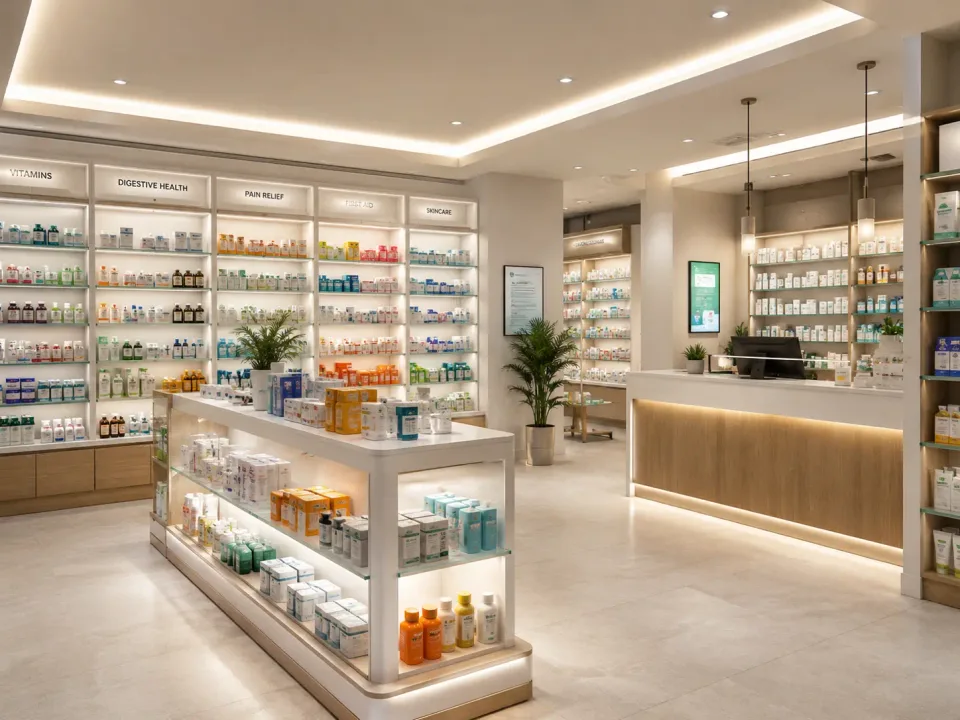
- Customers served Customers served during the ongoing pilot.
- 1,412
- Shopping and product-advice tasks resolved by AI Shopping and product-advice tasks resolved by AI; clinical questions are directed to a pharmacist.
- 92%
Community pharmacy
An AI associate that knows the pharmacy floor